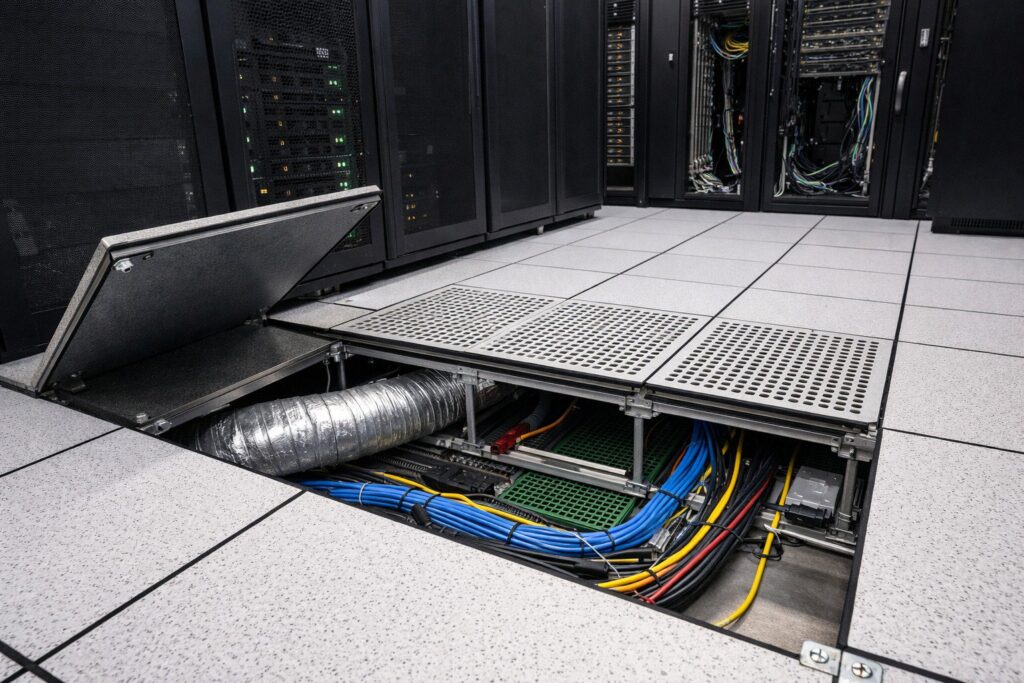
The access floor beneath a data center or cleanroom does far more than provide a surface to walk on. It manages airflow, routes power and data cabling, and supports equipment that can weigh several thousand pounds per rack. Choosing the wrong panel puts uptime, compliance, and safety at risk. Fixing those mistakes after installation costs far more than getting the specification right from the start.
Whether you are designing a new hyperscale facility or upgrading an existing critical environment, the right access floor panel selection starts with understanding what your loads actually demand.
Understanding Load Ratings: Concentrated vs. Uniform
Access floor panels carry two distinct load ratings. Conflating them is one of the most common specification errors in data center design.
- Concentrated load is the maximum weight a panel can support over a small contact area, such as the footprint of a server rack caster or leveling foot.
- Uniform load is the weight distributed evenly across the entire panel surface.
These ratings are not interchangeable. High-density server racks, UPS units, and AI compute cabinets apply concentrated loads. Their weight channels through just a few contact points. As a result, a panel with a strong uniform load rating can still fail under a 2,000-pound AI rack if its concentrated load rating is too low.
General load guidance by environment type:
| Environment | Recommended Concentrated Load |
|---|---|
| Standard compute and networking | 1,000 to 1,500 lbs |
| High-density AI and GPU racks | 2,000 lbs or more |
| UPS, battery, and power systems | 2,000+ lbs with stringer support |
| Cleanroom and semiconductor | Varies by ISO class and equipment spec |
Always start with a load analysis and floor plan review, not a product catalog. Match products to your load requirements, not the other way around.
Access Floor Panel Construction Types
Not every access floor panel is built for the same purpose. The construction type determines the balance of strength, weight, cost, and environmental suitability.
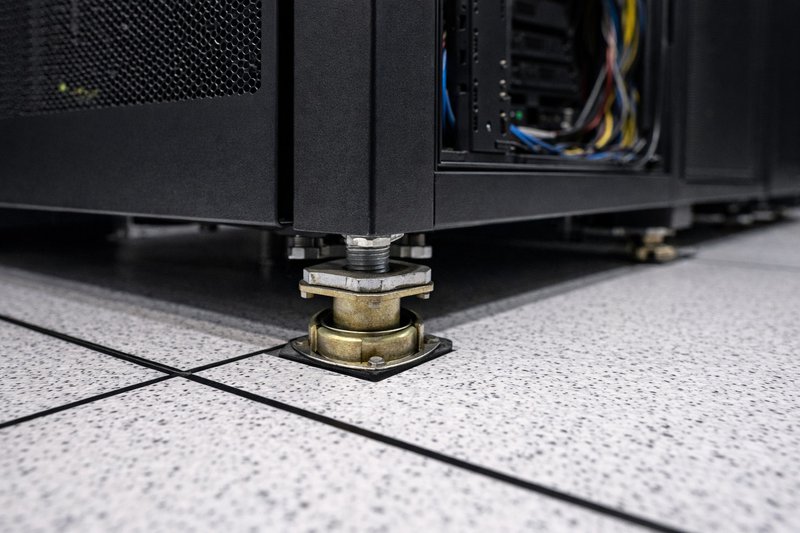
- Steel Encapsulated Panels: These are the most widely used panels in data centers. They feature a steel top skin, a steel bottom pan, and a concrete or calcium sulfate core. They offer excellent rigidity and consistent load performance, so they work well for environments with stable, predictable equipment layouts.
- Calcium Sulfate Panels: These panels are preferred where dimensional stability, moisture resistance, and fire performance are top priorities. They are heavier than aluminum, but they provide high load ratings with minimal deflection under stress.
- Aluminum Panels: Aluminum is the go-to choice for cleanrooms and semiconductor facilities. It is non-magnetic, non-corroding, and inherently anti-static when properly finished. In ISO-classified environments, aluminum panels also eliminate the particulate risk that corroding steel substrates can introduce beneath surface finishes.
- Stringerless Systems: These offer greater flexibility for cabling and subfloor access. However, they sacrifice some structural rigidity in exchange. For high-load applications, stringered systems remain the standard because the pedestal-and-stringer grid distributes point loads more effectively across the floor.
Choosing the Right Surface Finish
The top surface of your access floor panel matters just as much as the structural core beneath it. The wrong finish can introduce contamination risk, electrostatic discharge (ESD) hazards, or premature wear. In critical environments, worn finishes generate particulate debris that equipment simply cannot tolerate.
- High-Pressure Laminate (HPL): Standard in most data center environments. It is durable, easy to clean, and available in resistivity ratings that meet ESD control requirements.
- Conductive or Dissipative Vinyl: The preferred option for cleanrooms and pharmaceutical manufacturing. It meets ESD requirements while supporting the strict cleaning protocols required under ISO 14644 and FDA 503 standards.
- Bare Aluminum (Perforated): Common in open-grid cleanroom flooring where airflow uniformity takes priority. The perforated format maintains laminar airflow patterns without the pressure irregularities caused by worn panel edges or seams.
Seismic and Lateral Load Considerations
Vertical load capacity gets most of the attention during specification. However, lateral load resistance is equally important in many environments.
Standard access floor systems are designed to resist vertical loads. Without seismic stringers and lateral bracing, a floor grid can rack and shift during a lateral force event. For facilities in high-seismic zones, ASHRAE guidelines and local building codes require elevated lateral load ratings and supplemental bracing. These requirements must be addressed in the design phase, not the construction phase.
Facilities where heavy equipment is frequently repositioned face similar concerns. Even routine moves of high-density cabinets introduce lateral stress over time. Specifying a stringered system with seismic hardware from the start is a straightforward investment that protects the floor grid across the full life of the facility.
Why Access Floor Lead Times Are Breaking New Build Schedules
One of the most underappreciated risks in data center construction is access floor procurement lead time. When a project falls behind schedule, flooring is often the reason.
Many traditional vendors operate on lead times of 12 to 20 weeks for standard tile specifications. On a hyperscale build, that kind of delay is not just a logistical inconvenience. It pushes back rack installation, power commissioning, and final acceptance testing. In turn, that delay means deferred revenue.
This is where SET3's authorized dealer relationship with ASP Access Floors creates a clear advantage. Through the ASP product line, SET3 delivers precision-engineered tiles, pedestals, and stringers faster and more cost-effectively than legacy competitors. For new builds, that speed advantage directly improves project economics:
- Shorter lead times mean earlier equipment installation
- Earlier installation means earlier commissioning
- Earlier commissioning means earlier revenue generation
The ASP product line is not a budget compromise. These are high-performance components trusted in data centers, cleanrooms, and advanced manufacturing environments worldwide. Furthermore, SET3 combines that product quality with the expertise to specify, procure, and install correctly the first time, without the delays that plague standard vendor channels.
Installation: Where the Right Panel Still Needs the Right Team
Selecting the correct access floor panel is only half the equation. Installation execution determines whether that panel actually performs as designed. This matters especially in operating facilities. Even partial floor replacement creates real risk, including displaced equipment, exposed subfloor conditions, and contamination events.
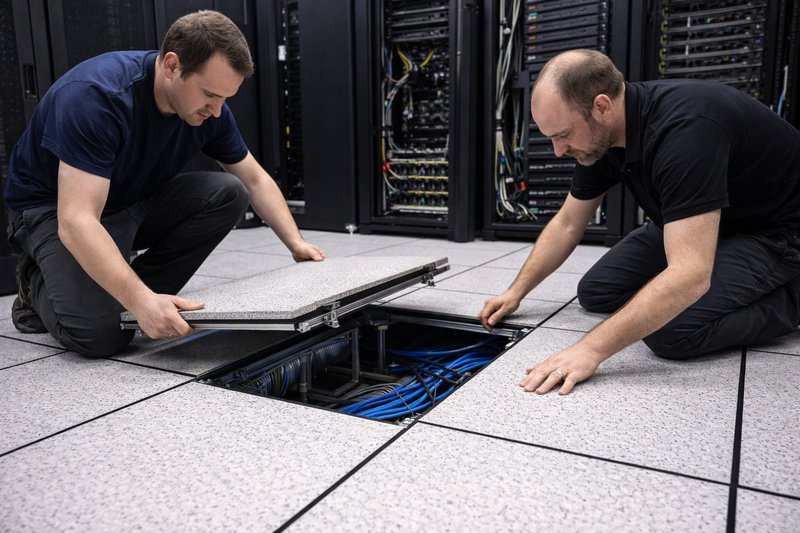
SET3 addresses this through two integrated capabilities.
- AirWolfX Live Rack Lifting: SET3's AirWolfX equipment relocation system can lift entire rows of active server cabinets, including high-density AI racks, without powering down a single machine. As a result, access floor replacement, panel upgrades, and subfloor remediation can proceed beneath fully operational equipment with zero downtime.
- Critical Environment Installation Expertise: SET3's installation teams work specifically in data center and cleanroom environments. They understand contamination protocols, ESD handling, and the operational sensitivity of every space they enter. For new builds, that expertise translates into clean, compliant installations that meet load specifications and airflow requirements from day one.
For more on how the subfloor connects to overall data center performance, the SET3 guide on raised floor systems in modern infrastructure covers how to identify and maintain these systems across different facility types.
The Right Partner Makes All the Difference
Access floor selection has long-term consequences. The panels you install today will be in service for a decade or more. During that time, they will support equipment that may not yet exist in its final form. Because of this, specifying conservatively on load capacity is not over-engineering. It is sound risk management for infrastructure that cannot afford to fail.
SET3 brings over 30 years of critical environment expertise to every access floor engagement. That includes specification consulting, ASP product supply, expert installation, and ongoing subfloor cleaning and maintenance. With the ASP Access Floors product line available through SET3, new build projects get the speed and pricing advantage they need without sacrificing quality.
Ready to specify the right access floor system for your facility? Contact SET3 today to speak with a critical environment specialist.