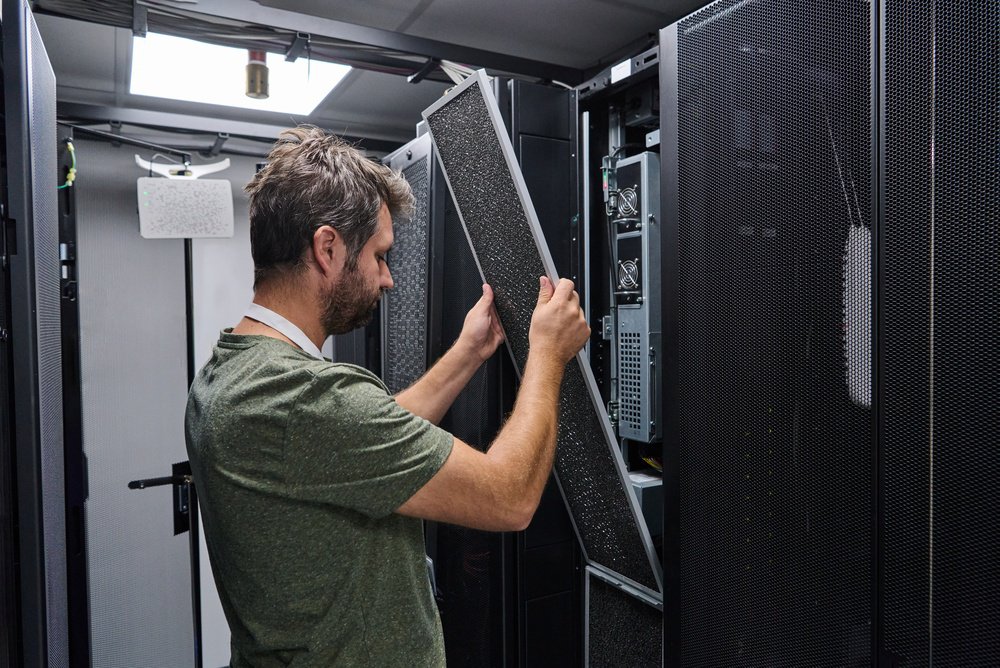
Data center managers face a persistent budgeting challenge: justifying preventative maintenance costs when operations appear to be running smoothly. Server cleaning rarely makes it to the top of the capital expenditure list, yet the costs of skipping it consistently outpace the costs of scheduling it. Understanding the real financial equation behind proactive interior server and equipment cleaning changes how facility leaders approach uptime, hardware longevity, and total cost of ownership.
What Is Interior Server Cleaning and Why Does It Matter?
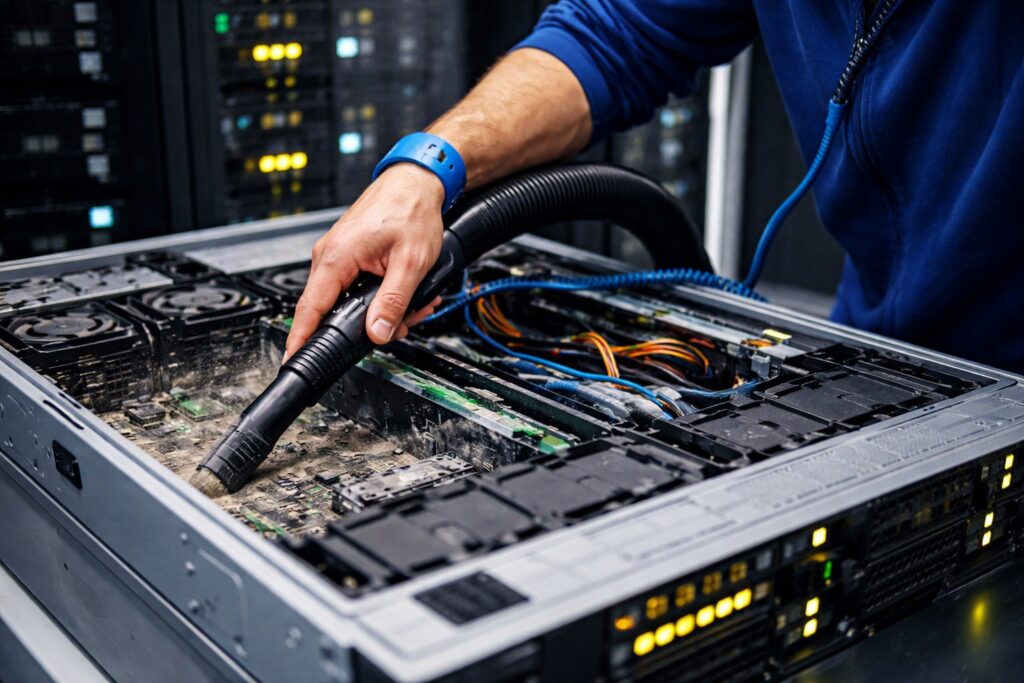
Interior server cleaning is the professional removal of dust, debris, ionic contaminants, ferrous metal particles, and other microscopic pollutants from within active server cabinets, network equipment, storage arrays, and other critical electronics. Unlike general facility cleaning, this work requires trained technicians who understand electrostatic discharge (ESD) risks, contamination protocols, and the sensitivities of live data center hardware.
Air-cooled servers and network equipment act as the first filter for air circulating through a data center. Over time, that air carries cement dust, acoustical ceiling powder, skin flakes, drywall particulate, and airborne debris from foot traffic and HVAC systems. The result is a slow accumulation of contamination that most facilities cannot see but absolutely cannot afford to ignore.
According to SET3's research, 78% of unexplained data center downtime is attributable to dust and micro-contaminants. That figure reframes server cleaning from a discretionary line item into a core risk management strategy.
The Real Cost of Contamination: A Breakdown
Before calculating ROI, facility managers need to understand the full cost profile of contamination-related failures. These costs fall into several categories.
Hardware Failure and Replacement
Dust buildup restricts airflow inside server chassis, causing internal temperatures to rise. Research published by ASHRAE confirms that for every 10°C increase in operating temperature, the Mean Time Between Failures (MTBF) for electronic components drops by up to 50%. That directly shortens the effective service life of servers, switches, and storage units that represent significant capital investments.
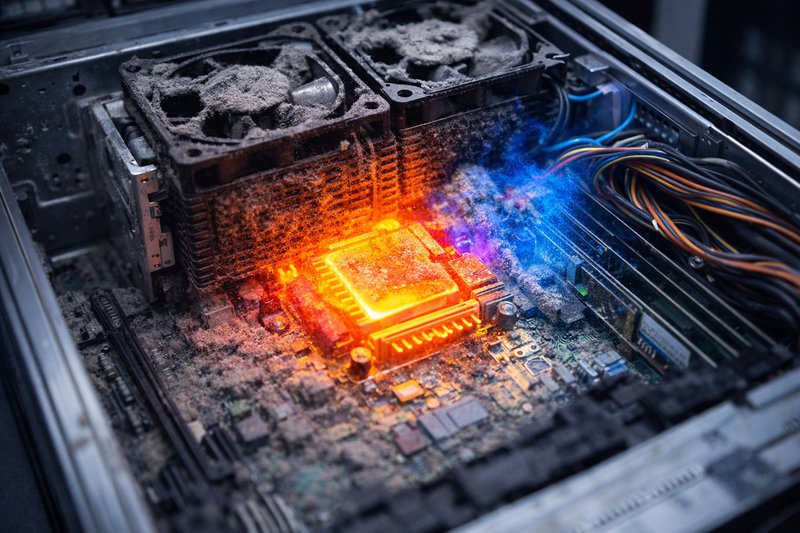
When contamination goes unchecked long enough, hard failures follow. These can require emergency part replacements, full board swaps, or complete equipment write-offs, all at unplanned expense.
Unplanned Downtime
Industry data from Uptime Institute's annual reports consistently places the average cost of unplanned data center downtime at tens of thousands of dollars per hour, with enterprise-class environments reaching six figures in some incidents. The root causes of these outages increasingly trace back to environmental contamination, not software bugs or network failures.
Downtime costs are rarely limited to IT remediation. They cascade into:
- Lost revenue from disrupted services or transactions
- SLA penalties triggered by uptime agreement violations
- Labor costs for emergency response and extended recovery efforts
- Reputational damage that affects client retention and future contracts
Energy Inefficiency
Contamination-clogged hardware runs hotter and works harder. Cooling systems compensate by drawing more power, which inflates energy costs across the facility. For large-scale data centers where power is a primary operational expense, the financial drag from reduced thermal efficiency compounds over months.
Soft Failures and Data Integrity Risks
Not every contamination-related problem results in a hard shutdown. Ionic contaminants on circuit boards accelerate oxidation and can trigger memory errors, intermittent misreads, and software instability. These soft failures are often misattributed to application bugs or network issues, leading to costly troubleshooting cycles that never address the actual cause.
The Cost of Proactive Server Cleaning
The cost of professional interior server cleaning varies by facility size, equipment density, and frequency of service, but the general model for most enterprise data center environments involves scheduled cleaning visits on a quarterly, semi-annual, or annual basis.
Typical investment considerations include:
- Service frequency based on facility traffic, construction activity, and environmental conditions
- Scope of work covering server interiors, network equipment, storage arrays, and cabinet exteriors
- Specialized materials including HEPA/ULPA vacuums, antistatic ESD-safe chemicals, and lint-free wipes
- Technician certification and insurance coverage appropriate for live data center environments
SET3, for example, carries $5 million in specialized data center and cleanroom insurance, a standard that far exceeds typical commercial cleaning providers. That level of professional coverage is factored into service costs and reflects the real liability involved in working inside mission-critical environments.
Running the Numbers: Where ROI Becomes Clear
The ROI case for regular server cleaning becomes straightforward when the avoided cost model is applied. Consider the following comparison for a mid-tier data center operating 20 to 50 server cabinets.
Without Proactive Server Cleaning:
- One unplanned downtime event per year, averaging 4 hours: $40,000 to $200,000 in direct costs
- Accelerated hardware refresh cycles due to reduced MTBF: 15 to 20% shorter equipment lifespan
- Emergency remediation and component replacement costs: variable, often unbudgeted
- Increased cooling energy costs from thermal inefficiency: 5 to 15% higher than a clean environment
With Scheduled Server Cleaning:
- Annual professional service cost: predictable, budgetable, and significantly lower than a single downtime event
- Extended hardware lifespan by reducing thermal stress and ionic corrosion
- Stable energy consumption with properly maintained airflow
- Reduced risk of SLA penalties and reputational fallout
The math favors prevention in nearly every scenario. The average cost of a single unplanned outage exceeds the cost of multiple years of scheduled server cleaning service.
Construction and Renovation: When the Risk Spikes
Post-construction cleaning represents a specific high-risk window where proactive server cleaning becomes urgent rather than optional. Any construction or major renovation activity adjacent to or within a data center generates significant particulate contamination. Drywall dust, concrete particles, and airborne debris migrate quickly through HVAC systems and into open server chassis.
Facilities that skip professional cleaning following construction activity often discover contamination-related failures weeks or months later, when the source of the problem is no longer obvious and remediation costs have multiplied. A proactive cross-contamination plan established before construction begins is the standard for any facility serious about uptime.
Subfloor Contamination: The Hidden Threat Beneath Your Servers
Interior server cleaning does not exist in isolation. The subfloor and raised floor plenum beneath data center equipment is a primary source of airborne contamination that migrates directly into server hardware. Concrete dusting, accumulated debris, and improperly sealed subfloor decks consistently feed particulate matter into the airstream that air-cooled equipment draws from below.
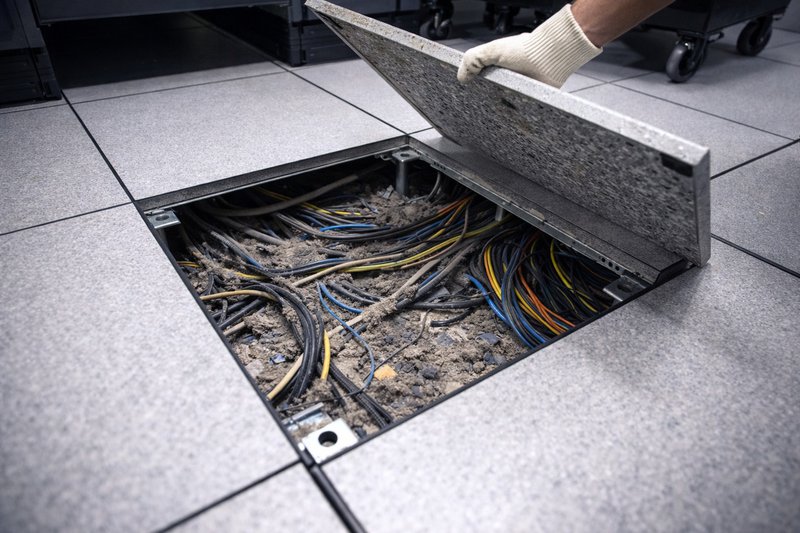
Addressing subfloor contamination alongside interior server cleaning creates a more complete contamination control environment and reduces the frequency of equipment-level cleaning required to maintain safe operating conditions.
What to Look for in a Professional Server Cleaning Partner
Not every cleaning vendor is qualified to work inside a live data center. Facility managers evaluating service providers should assess the following criteria.
- Technician background checks and vetting: All personnel should be fully vetted with documented credentials
- ESD safety protocols: Technicians must use antistatic tools, wrist straps, and ESD-safe materials
- Live environment experience: Server cleaning in an operational facility requires different protocols than cleaning an empty space
- Appropriate insurance: Minimum $5 million in specialized data center and cleanroom coverage
- Documented compliance: Experience with ASHRAE TC9, IEST, and ISO 14644 standards
- No-downtime capability: Professional cleaning should not require powering down your environment
SET3 performs interior server cleaning in fully operational facilities, meaning no scheduled maintenance windows and no disruption to services. That capability directly protects SLA commitments and eliminates the secondary cost of planned downtime that some cleaning engagements require.
Building a Proactive Maintenance Budget
Shifting from reactive to proactive data center maintenance is largely a budgeting and planning exercise. Facilities that treat server cleaning as a scheduled operational expense rather than an emergency response consistently demonstrate better hardware longevity, lower energy costs, and fewer unplanned outages.
For facilities managers building a contamination control budget, key line items to consider include:
- Scheduled interior server and equipment cleaning: Quarterly to annual, depending on the environment
- Subfloor plenum inspection and cleaning: Semi-annual minimum in active facilities
- Post-construction cleaning protocols: Mandatory following any construction activity
- Environmental testing and air quality certification: Supporting ongoing compliance documentation
Environmental testing and consulting services add another layer of ROI by identifying contamination risks before they reach hardware. Particle counts, airflow analysis, and power quality evaluations give facility managers data to make proactive decisions rather than reactive ones.
The Bottom Line on Server Cleaning ROI
Proactive interior server cleaning is one of the clearest examples of preventative maintenance with a measurable, positive return on investment. The cost of a scheduled cleaning program is predictable and controllable. The cost of contamination-related hardware failure, unplanned downtime, and accelerated equipment replacement is not.
Facilities that treat server cleaning as a recurring operational investment protect their hardware assets, preserve their uptime track records, and reduce total cost of ownership across the data center lifecycle. Those who defer it until a problem appears pay significantly more, often at the worst possible time.
If your data center does not have a scheduled server cleaning program in place, now is the time to establish one. Contact SET3 to discuss a proactive cleaning plan tailored to your facility's size, environment, and operational requirements.