Why You Should Never Use Your Subfloor for Storage
In data centers, airflow is everything. Many facilities rely on raised access floors to supply conditioned air that keeps sensitive IT equipment cool and operating efficiently. When you use the subfloor for storage—whether it’s old cables, unused tiles, tools, or other equipment—you disrupt the very system designed to maintain optimal performance. Every item placed under the floor creates turbulence in airflow, which can lead to inconsistent cooling and inefficiencies across your entire operation.
Subfloor Obstructions Create Airflow Turbulence and Hot Spots
The subfloor is part of your cooling infrastructure—not a storage unit. Introducing foreign objects below the floor surface blocks or redirects conditioned air in unpredictable ways. Instead of a smooth, pressurized airflow path to the front of your equipment racks, air is forced around obstacles, creating turbulence. This can lead to uneven cooling, with some areas receiving too much airflow while others—particularly near sensitive servers—receive too little. The result? Hot spots, poor thermo-regulation, and an increased likelihood of thermal shutdowns.
Poor Subfloor Practices Shorten Equipment Lifespan
When airflow is compromised, equipment temperatures rise. According to ASHRAE and NFPA standards, and supported by manufacturer best practices, every 10°F increase in temperature cuts the Mean Time Between Failures (MTBF) of data center equipment by roughly 50%. That means your servers, storage systems, and networking gear wear out faster, increasing replacement costs and downtime risks. What may seem like a harmless storage decision could significantly shorten the lifespan of your infrastructure—and your budget.
Best Practice: Keep Subfloors Clear and Conditioned
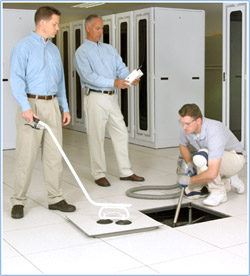
If your data center uses a raised floor to supply conditioned air, keeping that plenum clean and obstruction-free isn’t optional—it’s essential. Routine inspections and cleanings should be part of your regular maintenance plan to ensure air paths remain unobstructed and contaminants like dust and debris are removed. Think of your subfloor as a precision-controlled environment in itself: every degree and every airflow path counts when it comes to protecting uptime and performance.
Have questions about airflow management or need a subfloor audit?
SET3 specializes in clean, efficient, and compliant critical environments—from airflow optimization to raised floor inspections. Contact us to learn more.