
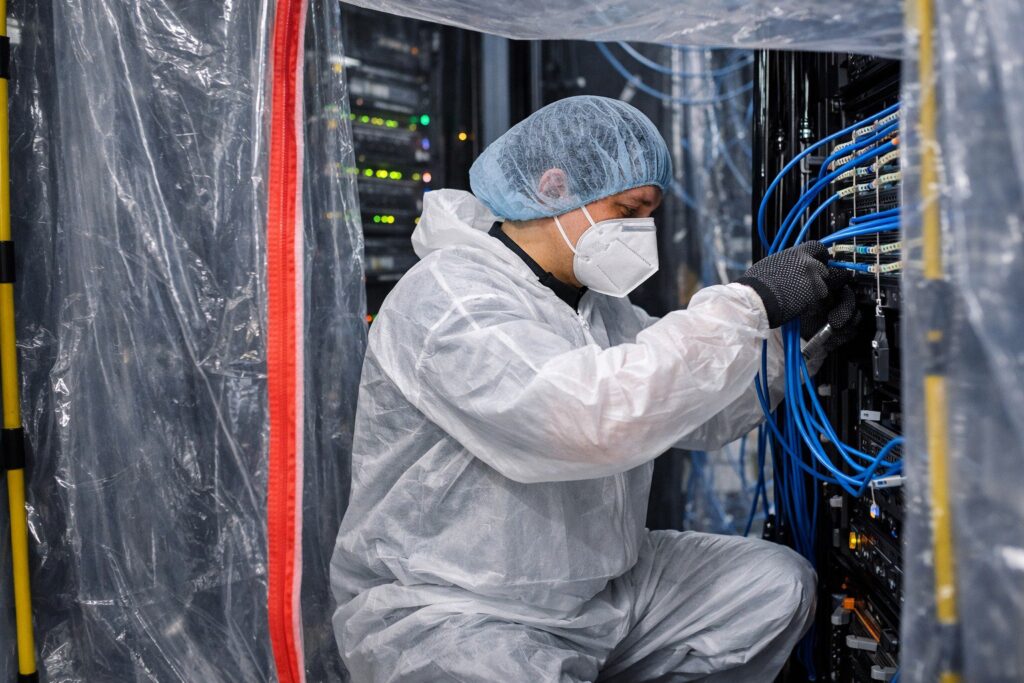
Structured data cabling projects rank among the most disruptive activities inside an active data center or cleanroom. Pulling cable, drilling pathways, and reconfiguring cable trays all generate debris, dislodge settled particulates, and introduce new contamination vectors into environments where cleanliness is directly tied to uptime. For facilities managers overseeing these projects, contamination prevention is not an afterthought. It demands the same rigor as the cabling work itself.
The consequences of getting this wrong are significant. A structured data cabling project without a proper contamination control plan can undo years of careful environmental maintenance in a matter of days.
Why Structured Data Cabling Projects Carry Such High Contamination Risk
Unlike routine maintenance activities, structured data cabling installations are inherently messy. Technicians work across multiple zones, including raised floor plenums, cable trays, and ceiling plenums. All of these zones are primary contamination pathways in a critical environment.
Several factors make these projects particularly hazardous from a contamination standpoint:
- Mechanical disturbance of settled particulate. Repositioning cable trays or lifting subfloor tiles can suspend decades of settled dust back into the airstream.
- Introduction of construction debris. Cable jackets, tie wrap offcuts, and termination scraps frequently end up in plenums when teams skip strict debris removal protocols.
- Fiber optic connector contamination. Fiber connectors are highly sensitive to dust. Even a single particle on a connector end face can degrade signal performance or cause intermittent faults.
- Disruption of airflow pathways. Improperly routed cabling can obstruct perforated tiles or restrict airflow channels beneath the raised floor. This forces cooling systems to work harder and raises the thermal risk to adjacent equipment.
- Static generation. Moving cable across floors and surfaces without proper static dissipation protocols introduces electrostatic discharge (ESD) risks to nearby sensitive electronics.
Understanding these risks before work begins is the foundation of effective contamination prevention.
Pre-Project Planning: Contamination Control Starts Before Work Does
The single most effective contamination control measure happens before any technician touches a cable. A detailed pre-project contamination control plan should address zone isolation, work sequencing, material staging, and post-work verification.
- Zone isolation involves physically separating the work area from active equipment spaces using temporary barriers, static-dissipative curtains, or pressurization controls. For structured data cabling projects that route through subfloor plenums, teams should seal off adjacent plenum sections to prevent disturbed particulate from migrating under equipment racks.
- Work sequencing matters as much as the physical controls. Teams should demolish old cabling before pulling new cable. Debris removal and plenum cleaning should come before any new terminations. Teams that run new cable into a contaminated environment before cleaning simply trap debris beneath the new infrastructure.
- Material staging should take place outside the critical environment whenever possible. Teams should bring cable drums, patch panels, and hardware into the space only as needed. All packaging materials should exit the space before staging begins.
Best Practices During Installation
Once work is underway, maintaining contamination discipline requires consistent process adherence across every technician on the job. The following practices are non-negotiable in any structured data cabling project in a critical environment.

- Use ULPA-filtered vacuums throughout the project. Standard shop vacuums, and even HEPA vacuums, are not appropriate for data centers or cleanrooms. Teams should only use certified ULPA vacuums to capture particulate generated during drilling, cutting, or cable pulling.
- Cap all fiber connectors until testing. Fiber optic cable connectors should remain capped at all times until the moment of testing and termination. Before testing, technicians should clean each connector with an appropriate click-cleaner or cassette cleaner. Standard cabling practice guidelines require this step, and it is essential for maintaining signal integrity.
- Implement a cut-and-capture protocol for cable prep. Teams should capture every piece of cable jacket stripped, every tie wrap cut, and every piece of scrap at the point of generation. Loose debris left in cable trays or on raised floor surfaces will migrate into the airstream.
- Use lint-free and ESD-safe materials. Standard rags, cardboard, and foam packaging materials are not appropriate inside a critical environment. All wipe-down materials should be lint-free. Technicians handling cable near live equipment should use static-dissipative gloves and work surfaces.
- Restrict personnel access. Every person who enters the work area is a contamination source. Hair, skin cells, clothing fibers, and footwear debris all raise the particulate load in a critical environment. Managers should limit entry to essential personnel and require all entrants to follow proper gowning protocols, including tacky mats at entry points.
Managing the Subfloor and Ceiling Plenum During Cabling Work
The raised floor subfloor is the most contamination-sensitive area any structured data cabling project will touch when routing cable below the floor. Subfloor plenums serve as the primary cooling air pathway in most data centers. Any debris introduced there will circulate directly through equipment.
Before lifting any tiles for cable routing, teams should complete a thorough subfloor inspection and cleaning. Unsealed concrete subfloors are a particular concern. They continuously generate fine concrete dust through a process called efflorescence. Any structured data cabling project involving subfloor work in a facility with an unsealed concrete deck should include concrete sealing in the project scope.
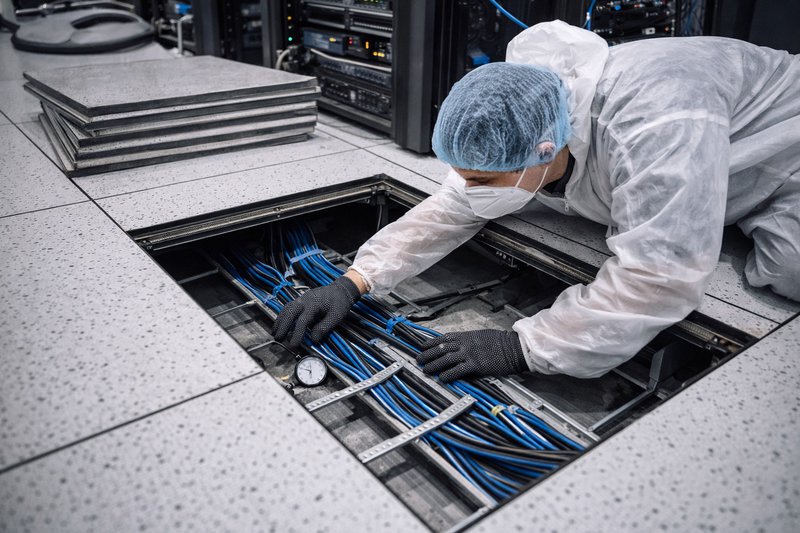
Similarly, teams should clean and inspect ceiling plenums before introducing new cable runs. Ceiling plenum debris, including acoustical tile powder, drywall particulate, and belt debris from air handling units, can fall through ceiling tiles during pressure changes. Those pressure changes occur every time a tile is removed or reinserted. Ceiling plenum cleaning by a qualified critical environment provider should be complete before any overhead cabling work begins.
Post-Project Cleaning and Verification
Completing the structured data cabling installation does not end the contamination management process. A post-project cleaning and verification phase confirms that the environment meets its required cleanliness classification before normal operations resume.
Post-project cleaning for a structured data cabling project in a critical environment should include:
- A full surface cleaning of all disturbed areas, including cable trays, raised floor tiles, equipment surfaces adjacent to the work zone, and all new hardware introduced during the installation.
- Subfloor cleaning and inspection to remove any debris generated during cable routing and tile work.
- Ceiling plenum inspection to identify any debris introduced during overhead cabling activities.
- Air quality testing and particulate verification to confirm that particle counts have returned to within the acceptable thresholds for the facility's ISO classification.
Facilities that skip this verification step accept an unknown environmental risk. Without post-project air quality data, there is no way to confirm that the cabling project did not introduce contamination that will trigger latent hardware failures weeks or months later.
Involving a Critical Environment Cleaning Partner
Structured data cabling contractors specialize in network infrastructure. In most cases, they do not train in critical environment contamination control. The most effective approach is to bring a certified critical environment cleaning provider into the project team from the beginning, not as a cleanup crew after the fact.
A qualified partner will conduct pre-project assessments, establish contamination control protocols specific to the facility, provide real-time monitoring during work, and deliver a documented post-project environmental report. For data centers operating under ISO 14644 classification standards, this documentation also satisfies a compliance requirement.
SET3 has provided contamination control services for mission-critical environments since 1995, cleaning more than 70 million square feet of critical space. From pre-construction planning through post-project certification, SET3's technicians work alongside cabling teams to protect uptime throughout every phase of the project.
If you have a structured data cabling project planned and want to protect your environmental standards, contact SET3 to schedule a pre-project consultation.