
A cleanroom built to the wrong cleanliness standard costs money in both directions. Build stricter than the process requires and you carry filtration, gowning, cleaning, and certification costs that deliver no added protection. Build looser and you face compliance failures, product losses, and remediation bills that exceed what the upgrade would have cost. The standard that sets all of those parameters is the ISO class, and selecting the right one is one of the highest-value decisions in cleanroom design. Before committing to any class, it's worth mapping the full operating cost against the actual risk the process carries.
This guide covers how ISO class decisions work in practice, which industries map to which classes, and what factors to weigh when the right answer isn't obvious.
How the ISO Class System Works
Specifically, ISO 14644 classifies cleanrooms by the concentration of airborne particles allowed in the space. The scale runs from ISO 1, the cleanest class, to ISO 9, which matches a typical indoor environment. Each class then sets a maximum particle count per cubic meter at specific particle sizes.

Most critical environments fall between ISO 5 and ISO 8. ISO 5 is standard for aseptic pharmaceutical manufacturing and certain semiconductor processes. ISO 7 covers most pharmaceutical compounding, medical device assembly, and general biotech work. Electronics manufacturing, hospital pharmacies, and precision engineering commonly operate at ISO 8. Below ISO 5, classes 1 through 4 apply to advanced semiconductor fabrication and optics, where even nanometer-scale contamination affects yield.
However, the ISO class alone doesn't define a cleanroom. Air changes per hour, airflow pattern, pressure differentials, gowning requirements, and cleaning protocols all vary by class and by the regulatory framework that governs the process. For example, an ISO 7 room built to FDA 503 pharmaceutical standards looks different from one built to general industrial standards, even with the same classification number.
Matching ISO Class to Industry and Process
Different industries use ISO classification differently. Understanding where your process sits within these frameworks is the starting point for any ISO class decision.
Pharmaceutical and Compounding
Of all these industries, pharmaceutical manufacturing is the most tightly defined. Indeed, FDA 21 CFR Part 211 and EU GMP Annex 1 both map cleanroom requirements to specific operations. Aseptic fill-and-finish lines run in ISO 5 or better. Additionally, background environments for open sterile work typically hold at ISO 7. Closed-system processing and secondary packaging often operate at ISO 8. For compounding pharmacies, USP 797 and USP 800 set requirements that map to ISO 5 for direct compounding areas and ISO 7 or 8 for anteroom environments.
Semiconductor and Electronics
Semiconductor and electronics manufacturing uses ISO classification to control yield risk rather than product safety. Here, the relevant particle size is often well below 0.5 microns, and class requirements can be stricter than pharmaceutical standards. Consequently, advanced logic chip fabrication runs in ISO 1 through ISO 3 with laminar airflow systems and specialized surface materials.
Medical Devices
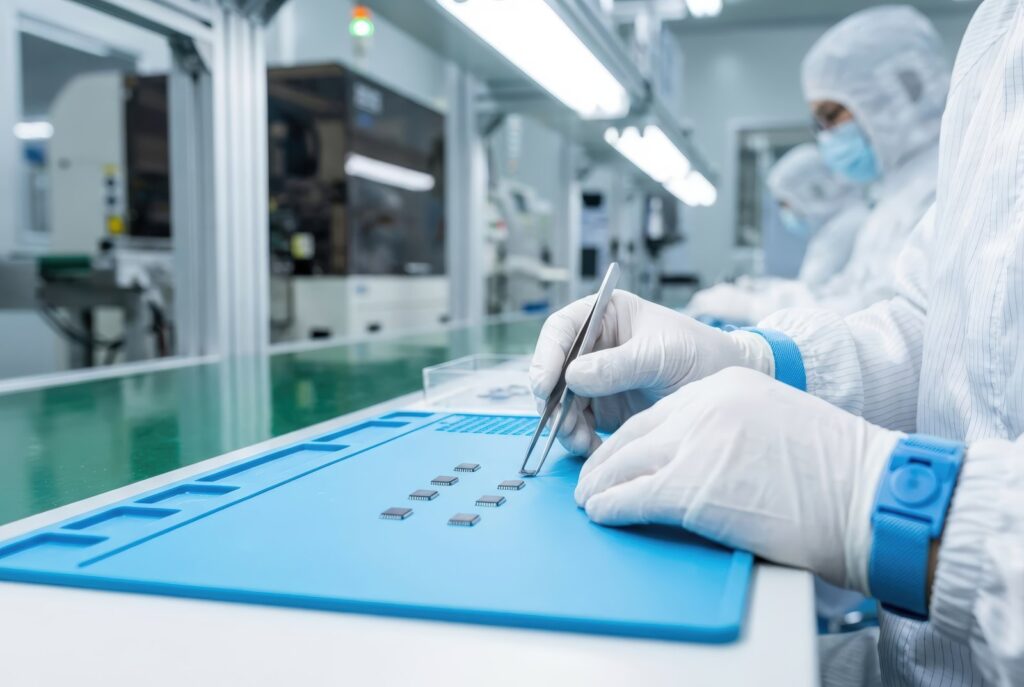
In contrast, medical device manufacturing covers a wide range. Class III implantable devices require ISO 5 or better for certain assembly steps. Class II devices typically run in ISO 7 or 8. Many manufacturers build to ISO 8 across the facility and add localized ISO 5 zones for critical assembly steps. That approach is often more practical than certifying an entire facility to a higher class. Moreover, the cost difference between the two is large enough to shape facility design from the start.
Aerospace and Defense
Aerospace and defense apply ISO classification to protect optical, electronic, and mechanical components from contamination that could affect field performance. ISO 6 and ISO 7 are common for assembly and integration work. Some programs also require controlled transition zones outside the cleanroom to maintain lower contamination levels during component transport.
The Factors That Shape the ISO Class Decision
In practice, the right ISO class isn't a single clear answer for many processes. Several variables push the decision in different directions.
First, regulatory framework matters as much as process type. A pharmaceutical operation follows FDA, EU GMP, or USP standards that may specify the class directly. However, an electronics manufacturer follows internal quality standards based on yield data. These two paths produce very different decision processes even if both land on ISO 7. When the regulatory path doesn't name a class, working from a process risk assessment is the most defensible approach. It ties the class decision to documented product sensitivity data rather than to convention or habit.
Additionally, product sensitivity is the other main driver. Some products tolerate moderate particle exposure without any effect on quality or function. Others, however, fail from a single contamination event. Therefore, the class needs to reflect actual product sensitivity, not a conservative estimate. Overbuilding to ISO 5 when ISO 8 would suffice adds significant operating cost without reducing risk.

Room use and personnel traffic also shape the choice. Specifically, a high-traffic space with frequent material movement generates more contamination than a low-traffic one. Sometimes the right answer is a lower-class room with tighter gowning and cleaning protocols, rather than a higher-class room with standard practices. Both paths can reach the same protection outcome at very different operating costs.
The Changes Between ISO Classes
Moving from one ISO class to another changes more than the particle count target. Each step up typically requires more air changes per hour, tighter filtration, more rigorous gowning, stricter cleaning, and more frequent certification.
For example, going from ISO 8 to ISO 7 roughly doubles the required air changes. It also adds a gowning transition area with its own controls. By contrast, going from ISO 7 to ISO 5 is a much larger step. It often requires single-direction laminar airflow, specialized surface materials, and full cleanroom suits with gloves, masks, and booties.
Together, these differences compound over time. Consequently, an ISO 5 room costs much more to operate than an ISO 7 room. The gap shows up in energy, filtration, gowning consumables, cleaning labor, and certification frequency. Understanding these costs before committing to a class is part of making a sound decision. In some cases, a hybrid approach works well. In fact, a lower-class primary environment paired with a higher-class critical zone delivers the needed protection at a fraction of the cost of upgrading the full facility.
How SET3 Supports ISO Class Decisions and Compliance
Overall, SET3 works across the full ISO class range, from ISO 1 through ISO 9. SET3's cleanroom testing services certify environments to their designated class and produce the particle count documentation that regulatory audits require.
Specifically, a baseline certification test is the starting point for facilities that aren't sure whether their current environment holds its rated ISO class. It produces a particle count profile that confirms compliance or shows where the environment falls short. From there, SET3's consulting services support remediation planning, protocol development, and audit preparation.
For new cleanroom design or renovation projects, SET3's consulting team models airflow requirements, reviews surface material selections, and helps match the ISO class decision to the regulatory framework and process requirements. ISO 14644-2 requires periodic monitoring and re-certification to maintain a classified environment. IEST contamination control standards provide additional guidance on monitoring protocols and documentation. SET3 has completed cleanroom certification work for government facilities including NASA and the U.S. Army, where class requirements vary widely and documentation standards are strict. That experience covers the full chain from baseline assessment through certification and compliance record maintenance. SET3's cleanroom cleaning services produce certified before-and-after particle count data after every Full Service Clean, which becomes part of the facility's ongoing compliance record.
To discuss the right ISO class for your specific process and get a certified baseline assessment, reach out to the SET3 team to learn more or request a quote.