

Choosing the right raised floor tiles is one of the most consequential decisions a data center or cleanroom manager will make. The wrong configuration can quietly sabotage your cooling efficiency, drive up energy costs, and create hotspots that put sensitive equipment at risk. The right one keeps your facility running at peak performance for years.
This guide breaks down the two primary tile types, high-flow perforated and solid, explains where each belongs, and walks through the cost-benefit analysis of building a raised access flooring system from the ground up.
What Is a Raised Access Floor System?
A raised access floor is a modular, elevated platform installed above a building's structural concrete slab. The space between the slab and the raised surface, called the plenum, serves as a dedicated utility layer for routing conditioned air, power cables, and network infrastructure. In data centers, this plenum acts as a pressurized cold-air reservoir, delivering chilled air directly to server equipment through strategically placed floor tiles.
Raised floor systems are composed of four core components:
- Panels — The walkable tiles, typically 24" x 24", constructed from concrete-filled steel, calcium sulphate, or woodcore materials
- Pedestals — Adjustable vertical supports that hold panels at the desired height above the slab
- Stringers — Horizontal beams that connect pedestals for added structural stability
- Perforated or solid tiles — The functional layer that determines where and how much air flows into the room
The decision between high-flow and solid raised floor tiles determines how that air moves through your facility.
High-Flow Perforated Raised Floor Tiles
High-flow raised floor tiles are perforated panels engineered to allow conditioned air to travel from the underfloor plenum directly into the data hall. They are the primary mechanism for cold aisle delivery in a hot aisle/cold aisle containment strategy.
How They Work
Perforated raised floor tiles feature precise perforation patterns across their surface. As pressurized cold air builds up in the plenum, it rises through these openings and enters the room at the front of server racks. The percentage of open area determines the volume of airflow. Standard configurations include:
- 25% open area — Moderate flow, common in lower-density environments
- 32% open area — A mid-range option suitable for mixed workloads
- 55–66% open area — High-flow configurations designed for dense server deployments and hotspot remediation

Directional perforated tiles have become the norm in sophisticated installations. Unlike older non-directional panels that allowed air to flow straight up, directional tiles guide conditioned air toward specific equipment, a significant advantage when targeting hotspots caused by high-density AI racks or blade server clusters.
Where to Use High-Flow Tiles
High-flow raised floor tiles belong in cold aisles, positioned directly in front of server rack intakes. Placement should be driven by a formal airflow study rather than guesswork. Deploying too many high-flow tiles in areas without sufficient static pressure can cause bypass air and uneven cooling distribution, which wastes energy without solving the thermal problem.
Best applications include:
- Cold aisles in hot aisle/cold aisle containment layouts
- High-density server rows, including AI and GPU rack clusters
- Areas with identified hotspots that overhead cooling cannot resolve
- Colocation suites where tenants require precise thermal control
Adjustable and Fan-Assisted Options
Standard perforated tiles work passively, relying on plenum pressure. For environments with particularly stubborn hotspots, adjustable damper tiles allow technicians to fine-tune airflow volume without removing or repositioning panels. Fan-assisted raised floor tiles go further, using powered airflow to deliver cool air directly to hard-to-cool areas without any rack downtime or repositioning.
Solid Raised Floor Tiles
Solid raised floor tiles are non-perforated panels that block airflow entirely. They make up the structural foundation of the raised floor system and serve a different but equally important function.
Where to Use Solid Tiles
Solid raised floor tiles are used everywhere that conditioned air delivery is not needed or actively harmful. Allowing cold air to bypass server intakes, flowing into hot aisles or empty floor spaces, wastes cooling capacity and drives up energy costs. Solid tiles prevent this by sealing off areas that don't require airflow.
Best applications include:
- Hot aisles, where cold air should not be delivered
- Areas beneath network switches, storage arrays, and other non-server equipment
- Walkways and transition zones between aisles
- Under UPS systems and power distribution units
- Sections of the floor where equipment density is low or non-existent
Well-designed facilities use solid and perforated raised floor tiles in deliberate combination. The ratio of solid to perforated panels should be calculated based on actual heat load data and plenum static pressure, not estimates.
High-Flow vs. Solid: Side-by-Side Comparison
| Factor | High-Flow Perforated Tiles | Solid Tiles |
|---|---|---|
| Primary function | Cold air delivery to equipment | Structural floor surface; air containment |
| Placement | Cold aisles, in front of server racks | Hot aisles, walkways, non-server areas |
| Airflow management | Active | Passive (blocking) |
| Cost per unit | Higher | Lower |
| Load capacity | Slightly reduced due to perforations | Maximum load capacity |
| Flexibility | Repositionable for cooling adjustments | Repositionable for layout changes |
| Best environment | High-density compute, AI racks | UPS rooms, storage areas, walkways |
The Cost-Benefit Analysis of Installing a Raised Access Flooring System
Installing a raised access floor system involves a higher upfront capital expenditure than a standard concrete slab. But evaluating that cost in isolation misses the full financial picture. The right framework is Total Cost of Ownership (TCO), factoring in energy savings, avoided downtime, infrastructure flexibility, and maintenance costs over the facility's operational life.
Upfront Costs
Material costs for raised floor panels vary significantly by type:
- Woodcore panels — Approximately $17 per square foot; suitable for lower-load environments
- Concrete-filled steel panels — Higher cost; preferred for data centers due to superior load capacity
- Aluminum panels — Premium pricing; ideal for cleanrooms and high-tech manufacturing environments
- High-flow perforated tiles — More expensive per unit than solid panels, but installed selectively rather than throughout the entire floor
Additional installation costs include pedestals, stringers, labor, and any structural modifications required to accommodate the elevated floor height, such as ramp construction or depressed slab work at entry points.
Long-Term Operational Savings
The financial case for raised access flooring becomes clear when operational savings are factored in:
- Cooling energy reduction — Properly configured underfloor air distribution can reduce cooling energy spend by up to 30%, with payback periods of two to four years on the floor premium
- Cable management efficiency — Routing power and data cables through the plenum eliminates overhead cable trays, reduces clutter, and lowers the cost of infrastructure changes
- Avoided downtime — The value of preventing a single unplanned facility outage can far exceed the material cost of the entire flooring system
- Reconfiguration savings — Rearranging perforated and solid tiles to accommodate new equipment requires no structural work; relocating power runs under a raised floor costs a fraction of core-drilling through a concrete slab
Scalability and Flexibility Value
Raised floor systems are highly modular. As equipment density increases or facility layout changes, tiles can be repositioned, replaced, or supplemented without taking the environment offline. This adaptability is particularly valuable as data centers adapt to evolving AI workloads, which often require rapid changes to cooling strategy and rack placement.
Organizations like ASHRAE and the Uptime Institute include raised access floors in their design recommendations for Tier-certified facilities, reinforcing the long-term credibility of the investment. Facilities that implement raised floors correctly may also qualify for LEED certification credits tied to energy efficiency improvements.
When the ROI Is Strongest
Raised access flooring delivers the clearest return in:
- Mid-sized to large data centers with hot aisle/cold aisle containment strategies
- Retrofit environments where overhead cooling changes would require significant structural modification
- Multi-tenant colocation facilities where flexible reconfiguration between tenant buildouts is a recurring need
- Regulated environments, including compounding pharmacies, semiconductor facilities, and government computing infrastructure, where contamination control under the floor is a compliance requirement
The Role of Subfloor Cleanliness in Tile Performance
One factor that undermines even the best-configured raised floor tile layout is a contaminated plenum. Dust, debris, and construction particulate accumulate beneath raised floor tiles over time, obstructing airflow pathways and reducing the efficiency of perforated tile delivery. In some cases, contamination can compromise ESD (electrostatic discharge) protection and clog equipment cooling fans.
SET3's subfloor cleaning services are specifically designed to address this problem in live environments. Using HEPA and ULPA vacuums, custom antistatic chemicals, and technicians trained to ASHRAE, ISO 14644, and IEST standards, SET3 cleans and decontaminates the plenum space without requiring downtime.
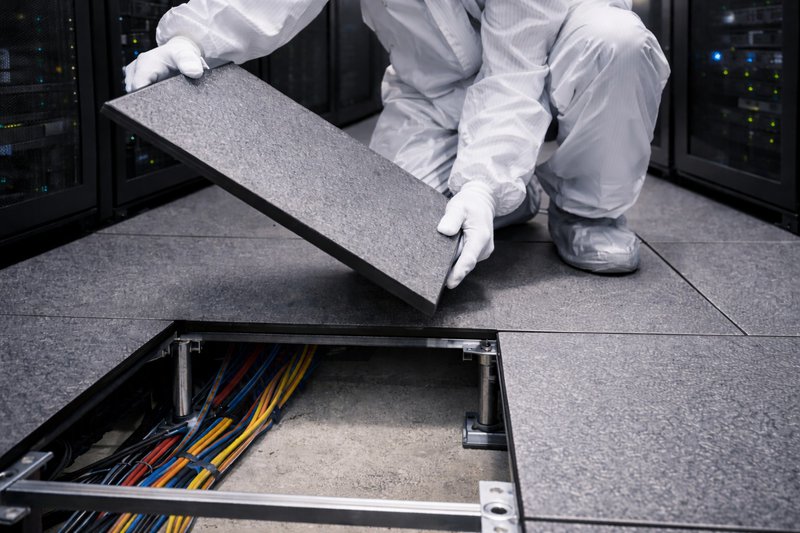
For facilities undergoing floor renovation or tile replacement, SET3 also provides raised access floor installation services, including ASP tile system design, subfloor deck sealing to prevent concrete dusting, and zero-downtime upgrades using the AirWolfX platform.
Additional products that support raised floor performance include:
- Floor grommets for sealing cable cutouts that cause bypass air
- Subfloor baffle systems for directing cold air precisely where it is needed
- Raised floor tile pullers for safe, ergonomic tile removal during maintenance
Making the Right Choice for Your Facility
There is no universal formula for the ratio of high-flow to solid raised floor tiles. The right configuration depends on your equipment layout, rack density, plenum static pressure, and CRAC or CRAH unit placement. A formal airflow study, including computational fluid dynamics (CFD) analysis, removes the guesswork and protects the investment you make in your floor system.
What is consistent across all facility types is this: raised floor tiles are not passive infrastructure. They are active tools for managing the thermal and contamination environment of your most critical equipment. Whether you are designing a new data hall, retrofitting an existing space, or troubleshooting persistent hotspots, the tile selection and placement strategy you choose will directly shape your facility's uptime, efficiency, and long-term operating costs.
Ready to evaluate your raised floor configuration or schedule a subfloor assessment? Contact SET3 to speak with a critical environment specialist.