The Most Trusted Critical Environment Specialists in the Industry
With a relentless passion for excellence in contamination control, SET3 has earned a reputation for professionalism, precision, and proven results across more than 70 million square feet of cleaned space worldwide. Since 1995, we’ve supported the missions of Fortune 50 companies, federal agencies, pharmaceutical labs, and semiconductor manufacturers by protecting their most sensitive environments with unmatched expertise.
The “Big Three” Standards Your Partner Should Understand
Iso 14644-1 (Air Cleanliness Classification)
Ashrae TC 9.9 (Data Center Environmental Guidance)
iest-rp-cc018.5 (Cleanroom Cleaning Practices)
5 Questions to Ask Before You Sign a Data Center Cleaning Contract
These five questions help you confirm the vendor can control contamination, protect uptime, and prove results with measurable reporting.
What Equipment Do You Use, and What’s the Filtration Rating?
A credible data center cleaning team should rely on HEPA-filtered vacuums (commonly referenced at 0.3 microns) and low-lint, non-shedding wipes/mops. Ask how they prevent exhaust re-aerosolization and how tools are maintained and verified.
How Will You Prove Results?
Look for partners that can provide:
- Airborne particle counting
- Surface contamination testing (when relevant)
- Surface contamination testing (when relevant)
- Before/after documentation tied to your scope
If the answer is “we’ll make it look clean,” you’re missing the control loop.
How Are Technicians Trained for Critical Environments?
Training should cover:
- Cleanroom/controlled-environment behavior (gowning or equivalent protocols where required)
- Airflow awareness (how actions affect particle movement)
- ESD awareness and safe work practices around live hardware
- Working inside cold aisle/hot aisle layouts without disrupting operations
What Insurance and Liability Coverage Applies to Mission-Critical It Spaces?
Confirm coverage that matches high-value, high-availability environments and understand how incidents are handled. This is basic risk hygiene, not paperwork for procurement.
What’s Included Beyond “Floors and Vacuuming”?
A real scope addresses contamination reservoirs and airflow paths, not just what visitors can see.
Critical Areas Your Data Center Cleaning Partner Must Address
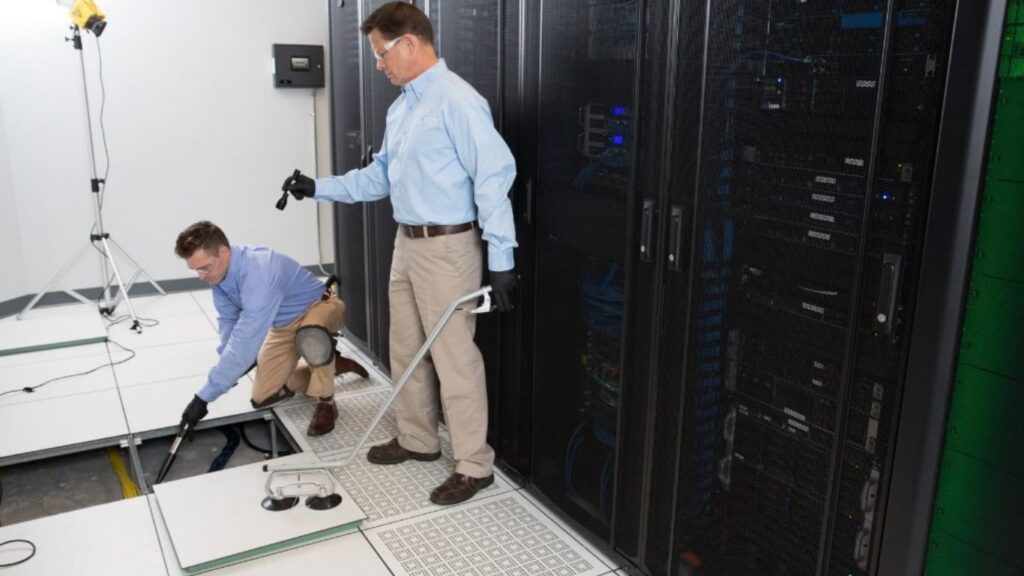
The highest-risk dust sits in hidden reservoirs like the subfloor, above-ceiling voids, and server intake zones. A qualified partner must address the following areas without re-aerosolizing debris or disrupting live operations.
- Subfloor plenums: Debris under raised access floors can be entrained into underfloor airflow and pushed toward equipment intakes. A partner should explain how they clean without stirring and redistributing subfloor dust.
- Above-ceiling voids: These spaces are easy to ignore and can drop debris onto racks or into returns. Ask how they inspect and clean overhead pathways safely.
- Hardware exteriors and intakes: Safe dust removal from server faceplates and intakes supports cooling efficiency. The team should know how to work around live gear without creating trip hazards or airflow blockages.
- Anti-static floor care: Raised access flooring systems often rely on dissipative properties. Using the wrong chemicals can undermine static control. Ask what products they use and why.
Quick Comparison Table: What “Good” Looks Like
For a quick diagnosis and to determine the proper steps, take a look at this table for reference. Start with the area, then what to look for, and why its effects matter.
Evaluation Area
- Tools & materials
- Verification
- Staff capability
- Scope coverage
- Documentation
Evaluation Area What to Look For
- HEPA vacuums, low-lint wipes, controlled methods
- Particle counts and/or surface testing reports
- Training in airflow, ESD awareness, live-hardware etiquette
- Subfloor, overhead voids, rack exteriors, floor care
- Before/after results + service record
Why It Matters
- Prevents re-aerosolization and shedding
- Turns “clean” into measurable control
- Reduces operational risk during work
- Targets contamination reservoirs
- Supports audits and repeatable maintenance
Proactive vs. Reactive: Why Scheduled Cleaning Pays Off
Reactive cleaning usually happens after alarms: hotspots, clogged intakes, unexplained failures, or visible dust events tied to construction and cabling work. Proactive cleaning is planned around operational windows, with verification that creates a baseline and shows drift over time. For most facilities, the value shows up as fewer surprises, cleaner airflow paths, and more predictable maintenance planning.
Where SET3 Fits
Sterile Environment Technologies (SET3) has specialized in contamination control for critical environments since 1995, supporting data centers, cleanrooms, and controlled facilities. Beyond cleaning and decontamination, SET3 can support air quality testing and certification, provide contamination control products, and consult on procedures that protect uptime.
For projects where access is tight and downtime is expensive, SET3’s equipment relocation capabilities can help teams clean or retrofit infrastructure while reducing risk to sensitive hardware.
Baseline Your Current Facility Condition With SET3
If you’re reviewing vendors or trying to reduce particulate risk, start with a measurable baseline. Talk with SET3 about data center cleaning and contamination control for your facility and request an environmental assessment or testing plan.