

A cleanroom that loses environmental control doesn't always show it. Temperature creeps above spec. Humidity rises past the allowed band. Particle counts climb. None of these appear in a visual inspection. By the time a shift in product quality traces back to an excursion, the batch is already lost and the investigation is already open. Real-time cleanroom environmental monitoring closes that gap before it reaches the product.
That risk spans every industry that operates in a controlled space. Pharmaceutical manufacturers face FDA 503 compliance requirements. Medical device makers answer to ISO 14644. Semiconductor fabs run to even tighter particle and humidity tolerances. In each case, an environmental deviation that goes undetected long enough turns into a quality event, a regulatory finding, or a product loss that far exceeds the cost of a monitoring system that would have caught it.
This article covers what real-time cleanroom environmental monitoring tracks, how it links to contamination control, and what a sound program looks like in practice.
What Cleanroom Environmental Monitoring Actually Tracks
A monitoring system collects data continuously across several parameters. Temperature and relative humidity are the baseline. Most controlled spaces set defined ranges for both, and deviations outside those ranges affect product quality, reagent stability, and equipment function.
Differential pressure is the next layer. A cleanroom holds positive pressure relative to adjacent areas to stop uncontrolled airborne particles from entering. When that pressure drops, the protection fails. Real-time monitoring catches pressure drops as they happen, not at the next scheduled manual check.
Airborne particle counts define a cleanroom's ISO class. ISO 14644 sets the allowable particle level at 0.5 microns and above for each class, from ISO 1 through ISO 9. A system that measures particle counts continuously gives the team a live view of whether the environment holds its rated class. Some systems also track carbon dioxide, volatile organic compounds, and other chemical parameters specific to the process running in the space.
How Monitoring Connects to Contamination Control
Environmental monitoring and contamination control work together. Monitoring tells you what the environment is doing. Contamination control then shapes what it does next.
When a system flags a particle count excursion, the first question is why. Has a HEPA filter failed? Did a gowning protocol break down? Did equipment malfunction? Without real-time data, the source investigation starts late and the corrective action follows even later. Moreover, monitoring supports root cause analysis when product quality issues come up. Instead of working backward from a failed batch to possible environmental causes, the team has a timestamped record that confirms or rules out an excursion. That distinction alone can save days of investigation.
This is also where SET3's cleanroom testing services connect directly to monitoring programs. Baseline particle count tests establish the certified condition the facility targets. When real-time cleanroom environmental monitoring detects a deviation, comparing it to that baseline shows how far the space has drifted and how urgently the team needs to act.
In pharmaceutical cleanrooms under FDA 503 standards, this documentation trail is mandatory. Consequently, the system must produce continuous records. Those records must link excursions to corrective actions. Furthermore, corrective actions must be on file before any batch produced during an excursion can clear review. That chain of evidence begins with real-time data and ends with a documented disposition.
Human Activity as a Primary Contamination Source
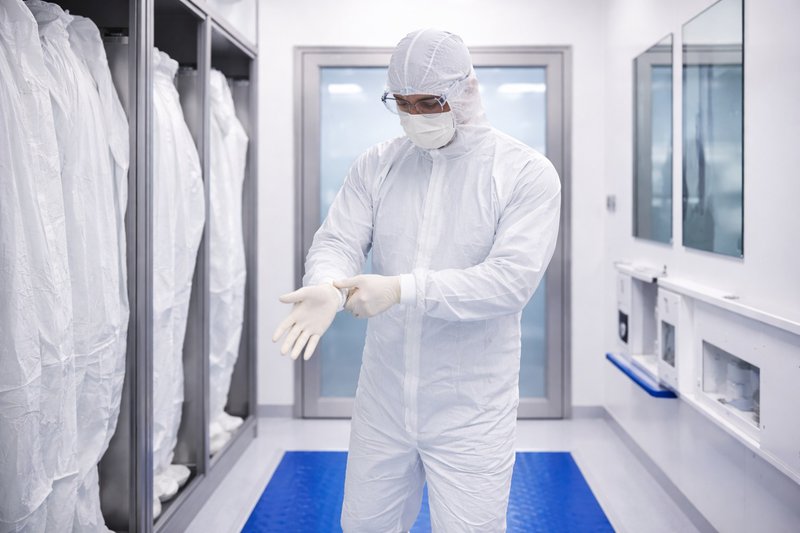
Cleanroom environmental monitoring data consistently shows that human activity drives the sharpest particle count spikes. A person entering a gowning room, moving between pressure zones, or moving equipment through a controlled area generates particle events that a well-designed system flags in real time.
However, this isn't a reason to minimize human presence in cleanrooms. Instead, it's a reason to pair human activity with controls. Tacky mats at entry points are one of the most cost-effective frontline tools. They capture particles from shoe soles and equipment wheels before they enter the space. SET3's store carries a full range of tacky mats for cleanroom entry use.
Gowning protocols, personnel flow patterns, and equipment transfer procedures all reduce the baseline contamination load the monitoring system has to track. The data then validates whether those controls are working. If particle counts spike at shift changes or after specific personnel enter, that signals the protocols need adjustment. Tracking these patterns over time is also one of the most practical uses of continuous monitoring data.
What a Sound Cleanroom Environmental Monitoring Program Looks Like
A sound cleanroom environmental monitoring program has four components: sensor placement, data logging, alert thresholds, and response procedures.
Sensor placement matters because cleanroom environments aren't uniform. Near-ceiling sensors may read differently from near-product sensors in the same space. Therefore, a program built on room geometry alone, rather than on where contamination would actually reach the product, misses its purpose.
Data logging must be continuous and tamper-resistant. Specifically, regulatory inspections in pharmaceutical environments review whether the system produced an unbroken record and whether any gaps have a documented explanation. Unexplained gaps become findings.

Alert thresholds must cover both the specification limit and the action limit. The specification limit is the hard boundary. The action limit sits below it, giving the team time to investigate before a full excursion occurs. Consequently, a system that only triggers at the hard limit gives the team less response time than one that alerts at the action limit first.
Response procedures close the loop. When an alert fires, who reviews it? What investigation follows? What counts as an acceptable corrective action? These answers need to be in writing before the first alert fires, not assembled afterward. SET3's consulting services include monitoring program design and audit preparation for facilities under ISO 14644, FDA 503, and IEST RP standards.
Connecting Monitoring to Cleaning and Certification
A monitoring program produces its most useful data when it runs alongside a regular cleaning and certification cycle. Particle counts taken right before and after a cleaning service confirm the cleaning reduced contamination to the target level. Similarly, counts taken between service cycles show how quickly contamination rebuilds under normal operating conditions. Both data sets matter for setting the right cleaning interval.
A facility that finds particle counts approach action limits within two weeks of a Full Service Clean has a clear case for more frequent service. One that finds counts stay well below action limits for six weeks has data to support a longer interval. In addition, a facility that has operated without continuous monitoring often discovers, once real-time data begins flowing, that its cleaning interval was either too frequent in some zones or not frequent enough in others. The data makes those misalignments visible in a way that a fixed schedule alone never does. Ultimately, the monitoring program is what turns a cleaning schedule into a measurable, evidence-based process rather than a fixed routine that may or may not match actual facility conditions. That evidence base also supports regulatory submissions, audit responses, and quality system reviews in ways that anecdotal cleaning records alone cannot.
According to the ISO 14644 standard for cleanroom classification, periodic cleanroom environmental monitoring and certification are core compliance requirements. IEST contamination control guidance reinforces this, setting benchmarks for monitoring frequency and documentation that regulated facilities use as a baseline. SET3's cleanroom cleaning services produce certified before-and-after particle count data that becomes part of the monitoring record and supports ongoing compliance documentation.
To learn how real-time cleanroom environmental monitoring fits into your compliance program, start a conversation with SET3 to learn more or place an order.