
Dust is one of the most underestimated threats in any data center. It accumulates silently, settles invisibly on circuit boards and cooling components, and degrades performance long before a failure event triggers an alert. Most operations teams focus on network monitoring, power redundancy, and cooling capacity, but skip over one of the most direct risk factors sitting inside every cabinet on the floor. Keeping a clean server rack interior is not a housekeeping preference. It is a core part of uptime strategy, thermal management, and hardware longevity.
What Accumulates Inside a Server Rack
The interior of a server rack is a high-velocity air environment. Fans draw air through the chassis constantly, and that airflow carries more than just heat. It carries particulate.
Common contaminants found inside server cabinets include:
- Concrete and cement dust from subfloor or construction activity
- Acoustical ceiling powder shed from overhead tile systems
- Human skin flakes and hair introduced by foot traffic
- Drywall and insulation particles after any renovation work
- Air handler belt debris, a conductive black powder from HVAC systems
- Ferrous metal particles that can oxidize and corrode circuit boards
- Zinc whiskers, conductive filaments that grow from galvanized metal surfaces and cause electrical shorts
Each of these particles behaves differently once inside the chassis. Some act as insulators, trapping heat. Others are conductive and can bridge electrical contacts. All of them create risk. Understanding what you are dealing with is the first step toward addressing it properly. SET3's interior server and equipment cleaning services are specifically designed to remove these contamination types safely in live environments.
The Direct Link Between Dust and Thermal Performance
Servers generate significant heat, and cooling that heat depends on unobstructed airflow through the chassis. When dust accumulates on heatsinks, fan blades, and vents, it acts as an insulating layer that traps heat against components.
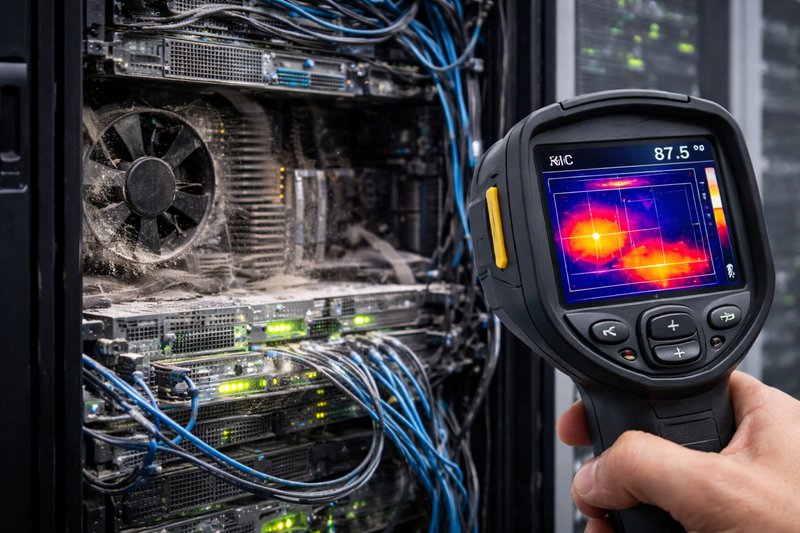
The thermal consequences are measurable and well-documented:
- Every 10°C rise in operating temperature can reduce Mean Time Between Failures (MTBF) by up to 50%, shortening the functional lifespan of processors, memory, and storage components
- Fan speed increases to compensate for restricted airflow, driving up energy consumption and mechanical wear
- Cooling system load increases as server outlet temperatures rise, putting additional pressure on CRAC and CRAH units
- Hot spots develop within racks, creating uneven thermal conditions that accelerate failure in concentrated areas
The relationship between contamination and cooling efficiency is direct. A clean server rack does not just look better. It runs cooler, draws less power, and places less strain on the infrastructure supporting it.
For a broader look at how contamination affects your facility's airflow systems, SET3's data center consulting services include airflow analysis and environmental assessments that identify cooling inefficiencies linked to particulate buildup.
How Dust Causes Hardware Failure
Beyond thermal effects, particulate contamination causes failures through two other distinct mechanisms: ionic corrosion and electrical interference.
Ionic Contamination and Corrosion
Dust particles are not inert. Many carry ionic compounds that accelerate oxidation on circuit board traces, solder joints, and connector pins. Over time, this corrosion degrades the conductivity of the board and introduces resistance where there should be none. The ASHRAE TC9.9 guidelines on data center environments specifically address the role of gaseous and particulate contamination in hardware degradation, noting that ISO 14644 Class 8 air quality standards should be maintained to protect sensitive electronics.
Electrical Shorts and Soft Failures
Conductive particles, including ferrous metal dust and zinc whiskers, can physically bridge electrical conductors on a board. This leads to two categories of failure:
- Soft failures: Memory errors, misreads, and unexpected reboots that may not immediately point to contamination as the cause
- Hard failures: Complete component shutdowns, irreversible damage, and PDU failures that require replacement
Both failure types are expensive. Soft failures are often the more dangerous of the two because they are difficult to diagnose. IT teams may spend hours troubleshooting firmware, software, or network configuration before identifying contamination as the root cause.
Uptime and Warranty Implications
The financial cost of unplanned downtime in a data center is not abstract. The average unplanned outages cost as high as $9,000 per minute, with hyperscale environments reaching well beyond that figure. A single contamination-related failure event can translate into six-figure losses when hardware replacement, labor, and service disruption are factored in.
There is also a warranty dimension that many operators overlook. Many hardware manufacturers require that equipment operate within ISO Class 8 air quality conditions as defined by ISO 14644. Operating in an environment that does not meet this standard, or failing to maintain clean server rack interiors, can void manufacturer warranties and leave organizations financially exposed when hardware failures occur.
SET3's data center testing and certification services provide the documentation needed to demonstrate compliance with ASHRAE, ISO 14644, and IEST standards, which supports both warranty protection and audit readiness.
Why Standard Janitorial Cleaning is not Enough
A clean server rack interior requires more than compressed air and a cloth. Standard facility cleaning crews are not trained to work in live critical environments, are not equipped with certified tools, and are not insured for the risks associated with data center work.
Interior server cleaning performed by untrained personnel can:
- Introduce static discharge that damages sensitive components
- Dislodge debris into active airflow paths, accelerating contamination spread
- Use the wrong chemicals that leave ionic residue on circuit boards
- Void equipment warranties if cleaning methods are not up to manufacturer standards
Professional cleaning for a clean server rack environment uses HEPA and ULPA vacuum systems, antistatic and ESD-safe chemicals specifically formulated for electronics, and technicians trained to ISO 14644, ASHRAE, and IEST standards. The difference between general janitorial service and certified critical environment cleaning is the difference between mitigating risk and introducing new ones.
SET3 technicians work in live data center environments routinely, cleaning interior server equipment without requiring downtime or shutdown windows.
Recommended Cleaning Frequency
How often a facility needs interior server rack cleaning depends on several variables:
| Factor | Recommended Frequency |
|---|---|
| Standard enterprise data center | Quarterly to semi-annually |
| High-density AI or GPU rack environments | Monthly inspections |
| Post-construction or renovation | Immediately following activity |
| Following HVAC maintenance | As soon as possible after work |
| Facilities with known zinc whisker risk | As directed after testing |
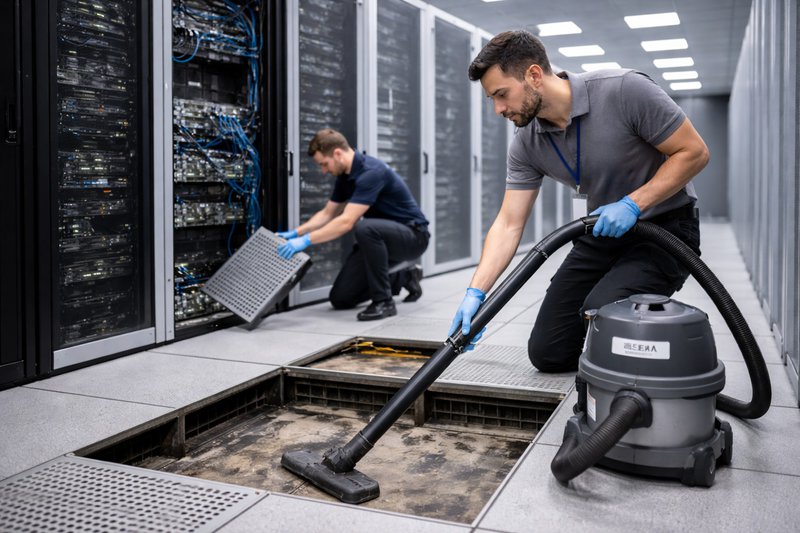
The subfloor environment also plays a direct role in what ends up inside server cabinets. Air-cooled equipment draws intake from the raised floor plenum, meaning anything circulating below the tiles will eventually reach the server chassis. SET3's subfloor cleaning services address this contamination pathway directly, removing the particulate at its source before it reaches hardware.
Building a Contamination Control Program
Keeping a clean server rack is not a one-time task. It is part of a broader contamination control program that addresses the facility holistically. A structured program typically includes:
- Scheduled interior server and equipment cleaning at intervals appropriate to the environment
- Subfloor and ceiling plenum cleaning to eliminate particulate sources that feed into server airflow
- Air quality testing and particle counting to establish baseline conditions and track changes over time
- Environmental reporting that documents particle data before and after service for compliance and audit purposes
- Post-construction cleaning protocols following any facility modification that generates debris
Organizations that treat contamination control as an ongoing operational discipline consistently see better hardware reliability, lower energy consumption from their cooling systems, and cleaner audit trails for compliance purposes.
The Bottom Line
A clean server rack interior is not a cosmetic concern. It is a measurable factor in thermal performance, hardware lifespan, uptime reliability, and regulatory compliance. The contamination that accumulates inside server cabinets is the same contamination that drives soft failures, accelerates corrosion, and ultimately leads to unplanned downtime in environments where downtime is never acceptable.
The science of clean exists precisely because these risks are real, documented, and preventable. The question for any data center operations team is not whether contamination is present, but how much has accumulated and what it is costing you.
Ready to protect your critical infrastructure? Contact SET3 to schedule an assessment or learn more about interior server cleaning programs tailored to your environment.